
 As a part of our Academy of Medical Sciences funded project on civil society and indigenous languages in India, we have conducted workshops among indigenous tribal communities in Rajasthan and Kerala, and discussed the issues and challenges they face, including safeguarding their culture, language and everyday socio-economic life.
By way of context, Rajasthan is home to several indigenous tribal communities and has the 6th highest tribal population in India (13.5% of the total population). The major tribal communities of the state include the Bhil, Mina, Garasia, Damor, Kathodi, and Sahariyas.
The Bhils
We have been examining the linguistic and cultural diversity of the Bhil communities. Popularly known as the bow men, the Bhils are one of the largest indigenous ethnic communities in India. In Rajasthan, they mostly reside in the southern half of the state. They live in the forests and highlands, and the primary sources of their livelihood are shifting cultivation, hunting, and collection of forest produce. In contemporary times, many Bhils have shifted to nearby cities to work as daily wage migrant workers.
Our workshop participants spoke of their common language, Bhili. It is a spoken language; it does not have any written script of its own. Indigenous knowledge, and myths and stories are transmitted orally from one generation to another. As Professor Ayesha Kidwai aptly notes, “Tribal languages are a treasure trove of knowledge about a region’s flora, fauna and medicinal plants. Usually, this information is passed from generation to generation. However, when a language declines, that knowledge system is completely gone. With the loss of language comes the loss of everything in culture and loss of solidarity, the loss of Man himself”.
A generational shift
Workshop participants expressed concern that their language is increasingly vulnerable in the face of a generational shift. Many younger Bhils are moving to the cities for education and jobs, and they do not use Bhili, instead preferring the dominant and aspirational languages – Hindi and/or English. The decline in indigenous language use is compounded for many Bhils who migrated to the cities and send their children to English-medium schools where they have no opportunity to learn Bhili.
Our workshop participants also spoke of how Bhil youths do not want to use traditional Bhil names like Virji, Hurji, and Mavji. For them, there is a sense of shame – they think that these names represent backwardness. Instead, they use Hindu or Biblical names. One key message that emerges from this is that Bhil youth’s conversion to modernity is having significant negative impact on the Bhili language.
Participants also spoke of state neglect and apathy contributing to the decline of their language. The government has not provided opportunities for young Bhils to learn their language and there are no language institutes. As Bhili is not a written language, it is not taught in schools. Instead, pupils are taught Hindi, Sanskrit, Urdu or Rajasthani languages. Importantly, because Bhili is a non-scheduled language, it has no official status – which increases its endangerment.
Notwithstanding, all these challenges, Bhili is still spoken by a large number of people in Rajasthan, Madhya Pradesh, Gujarat and Maharastra. It is not as vulnerable as the indigenous languages of the Irula of Kerala, yet necessary steps must be taken by state and civil society actors to stop it from dying.
A rich and diverse cultural history
Workshop participants discussed how, although they follow animistic practices and worship several local deities, their religious life is heavily influenced by mainstream Hinduism. They also worship Hindu gods and goddesses such as Ganeshji, Shivji, Durgaji and celebrate festivals like Gavari. This is one of the most popular festivals of the Bhils in south Rajasthan. It is an annual mythical folk dance-based festival performed by men that lasts for 40 days during the rainy season.
Even though Gavari is considered a vital aspect of Bhil cultural identity, several of our workshop participants spoke of tensions with modern life. They criticised the festival’s long duration. In order to perform this practice, many male members of the Bhil community do not return to the village for months and in the process, they lose their jobs, which keeps them in a perpetual cycle of poverty and indebtedness.
Workshop participants also spoke of how, in over 70 years of Indian independence, the Bhil community’s social and economic life has not improved much. State neglect (irrespective of which political party comes to power) has been a major factor. They expressed doubts that mainstream political parties can represent the interests of the Bhils. For them, these parties only make false promises and once the election is over, they disappear.
In response, many workshop participants noted that only Bhils can fight for their own rights, and they cited the example of Bharat Adivasi Party (BAP), which was founded by a young Bhil leader a year before 2024 elections. The party has won three state legislative assembly seats and one seat in the lower house of Indian Parliament. BAP has been advocating for Bhil rights and dignity. Most of the workshop participants were excited about this party and believed strongly that only political parties and civil society organisations led by young Bhils can improve the socio-economic conditions of the Bhils and restore their rich and diverse cultural history.
A new book based on our research will be published in the new year:
“Indigeneity, Culture and Citizenship in Today’s India: New Perspectives on the Bhil and Irula Peoples” by Sarbeswar Sahoo, Paul Chaney, Reenu Punnoose and Muhammed Haneefa
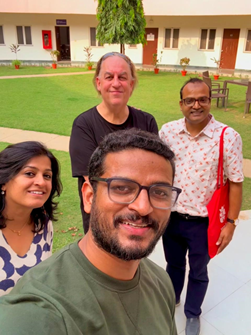
We gratefully acknowledge research funding by the Academy of Medical Sciences (Award No. NGR1\1042). The research team (pictured) comprises (L-R, front) Dr Reenu Punnoose (Indian Institute of Technology Palakkad) and Dr Muhammed Haneefa (Indian Institute of Technology Jammu), and (L-R, back) Paul Chaney (Emeritus Professor, Wales Institute of Social, Economic Research, Data and Methods, Cardiff University) and Professor Sarbeswar Sahoo (Indian Institute of Technology Delhi).