
 On 18 September 2026, we held a workshop in honour of the late Professor Howard Davis, former Professor of Social Theory and Institutions at Bangor University.
Colleagues, former students, friends, and family members came together in Bangor and online to remember Howard’s contribution to Cultural Sociology in Bangor, Britain and further afield, to his students’ intellectual growth, and to the wider University and local community. The workshop was organised by Dr Elizabeth Woodcock, one of Howard’s former PhD students.
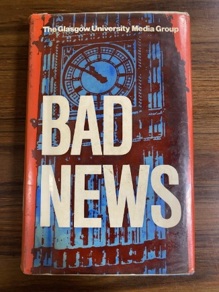
Howard’s son, Robin, started the event by reminding us of the significant contribution Howard made to the Glasgow Media Group in its radical early days, a period that shaped him as an academic while transforming British sociology and cultural studies in their study of how media institutions shape public understanding of the world. September also marked 50 years since Bad News (pictured), a landmark for cultural and media studies, was published.
 Howard’s former PhD students shared stories of Howard as a mentor and role model, leaving them with a deep sense of responsibility to academic rigour, integrity and standards, a moral responsibility to the next generation of academic scholars, and a strongly felt belief in the importance of connections made through personal relationships.
Dr MiYoung Ahn, now Lecturer of Sociology at Goldsmiths, University of London, and one of Howard’s former PhD students, exemplified the deep impact of Howard’s mentorship by saying how she keeps asking herself ‘What would Howard have done’ in her daily work as an academic?
Dr Marta Eichsteller, Lecturer at the School of Sociology at University College Dublin, another former PhD student, described Howard’s distinctive contribution to Sociology through three pillars defining his work and character. The first was his commitment to sociology as fundamentally relational: a discipline in which people of equal standing meet in genuine dialogue, exchanging ideas about difference and plurality rather than reproducing hierarchies of knowledge. The second was his deep interest in how people perceive their place in the world by listening to what people tell us. The third pillar was his respect for academic craft as a testimony to what it means to be an academic.
His colleague and friend, Dr Keith White, shared stories of Howard’s diverse virtues, his fine mind, musical ear, gift for languages, family background in China, his collaborative spirit and ability to forge relationships, and his Christian faith.
There were sides to Howard’s life and character that were new to all those present and his longstanding colleague and friend Sergei Erofeev added another string to the bow of Howard’s many contributions. Sergei highlighted Howard’s role in European sociology and in building Cultural Sociology in Russia in difficult circumstances, and the many years of academic collegiality and friendship this resulted in.
Professor David Lyon talked about how he shared his work in progress and his thoughts on surveillance with Howard, and how he was looking forward to sharing his latest thinking on surveillance as an Eye of God with Howard and to listening to his feedback. It became very clear that Howard’s quiet expertise and scholarship reached into different corners of the world.
Dr Robin Mann and Graham Day, Emeritus Professor of Bangor University reflected on Howard’s legacy of Cultural Sociology at Bangor, as well as his contributions to WISERD as longstanding Co-Director at Bangor, Sociology in Wales more broadly, and the influence he had on the intellectual life of the then School of Social Science as its Head. They continued this legacy with a fascinating discussion of identity work and cultural representation in far-right movements.
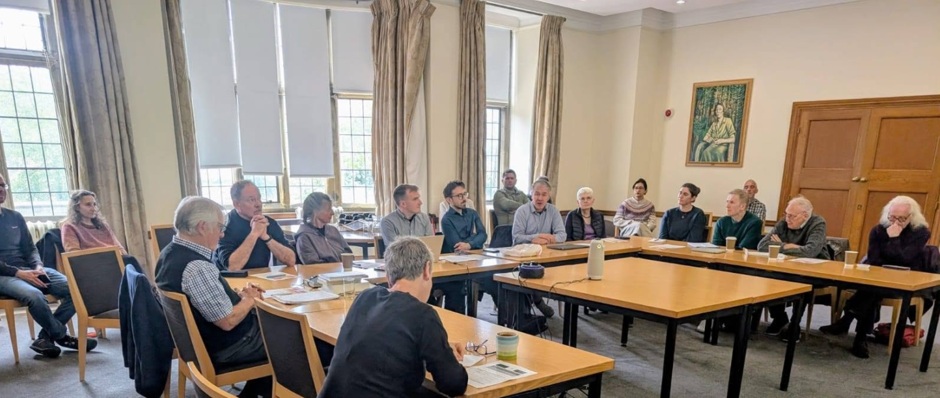
Over discussions and presentation, coffee and Bangor brownies, we learned of Howard’s complexity and versatility, his deep connections to people, his legacy as an academic, a mentor and role model, and as a friend. He was a deeply humble man, reticent to speak of his achievements and contributions, but there were clearly many.
Howard showed us the value of keeping conversations going across boundaries of culture, discipline and geography. We heard of Howard ‘the radical’, the man of academic rigour, the advisor, the Christian, and academic friend.
The presence of his family reminded us all that work is but one element of life. Howard was a husband, a father, and a member of his local church and community. What will remain with me is how it felt to be in a real and virtual room full of people who respected Howard as an academic, a friend, a family man – it was deeply humbling to recognise the significant legacy of a lifetime of academic service.