
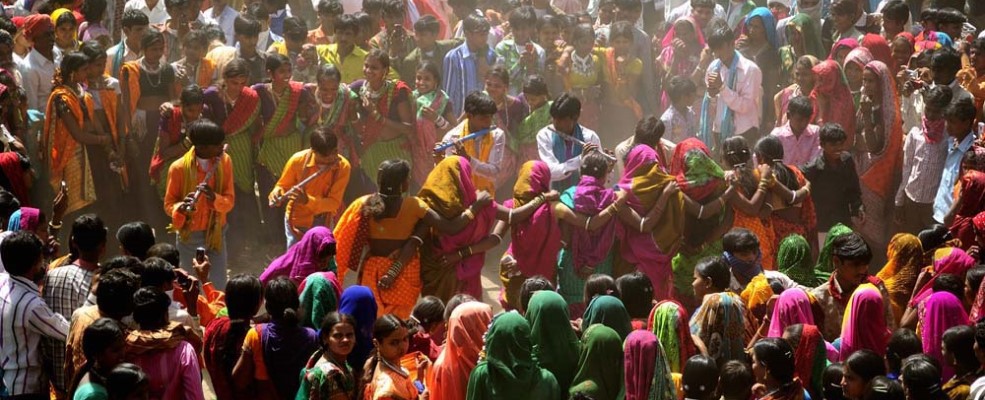
Our emerging research findings are published in two new non-technical briefing papers that reveal issues around indigenous peoples’ citizenship rights in India and the contemporary challenges they face in safeguarding their land, culture and languages.
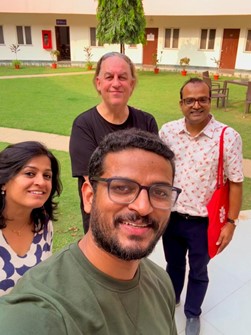
The research team comprises (L-R, front) Dr Reenu Punnoose (Indian Institute of Technology Palakkad) and Dr Muhammed Haneefa (Indian Institute of Technology Jammu), and (L-R, back) Paul Chaney (Emeritus Professor, Wales Institute of Social, Economic Research and Data, Cardiff University) and Professor Sarbeswar Sahoo (Indian Institute of Technology Delhi).
The first report examines the situation of the Bhil people in Rajasthan.
The Bhil are one of the oldest tribes in India and speak a language of Indo-Aryan origin. In this non-technical briefing, we draw on the findings of fieldwork, including workshops held in 2024-25 with indigenous peoples, civil society organisations (CSOs) and academics in India.
The second report examines the situation of the Irula people in Kerala.
Irula are the second largest tribe in Kerala. They live in the Attappady region of Palakkad District. The Irula language is an independent Southern Dravidian language that is akin to Tamil.
Our findings show that both tribal cultures are under threat. The Bhil and the Irula face challenges posed by economic development on their lands, in-migration that threatens their traditional ways, the exclusion of their languages in formal education provision, environmental degradation, poverty and inequality.
A further challenge is posed by generational differences, with some young people embracing aspirational consumerism and urban living, rather than traditional life. Our research also charts growing support for civil society action to address these issues.
A full account of our research findings can be found in this forthcoming book:
‘Indigeneity, Culture and Citizenship in Today’s India: New Perspectives on the Bhil and Irula Peoples’ (2026) by Sarbeswar Sahoo, Paul Chaney, Reenu Punnoose and Muhammed Haneefa (Bloomsbury Publishing, New Delhi).
Acknowledgments:
The research team wish to thank the Academy of Medical Sciences for funding under project No. NGR1\1042. They also wish to thank all the participants that took part in the research.
Image 1 credit: Adivasi – from dense forest to concrete forest – Adivasi youths dancing during colourful Bhagoriya festival on a market day in Bakhatgarh. Photo by Rohit Jain published under a CC-BY 2.0 licence.
Image 2 credit: The research team © Haneefa.