Publications

Sort by: |
Your search returned 650 results
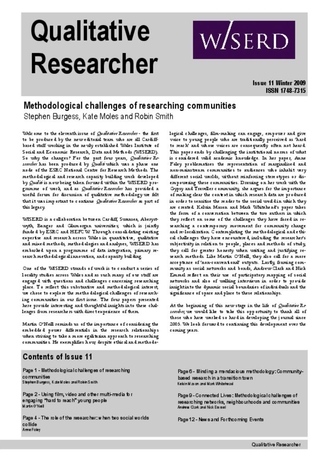
Issue front page
Methodological challenges of researching communities

Welcome to the eleventh issue of Qualitative Researcher – the first to be produced by the new editorial team who are all Cardiff-based staff working in the newly established Wales Institute of Social and Economic Research, Data and Methods (WISERD). So why the changes? For the past four years, Qualitative Researcher has been produced by…

Issue front page
Using film, video and other multi-media for engaging “hard to reach” young people

Increasingly in the field of conducting research based regeneration initiatives in disadvantaged or disengaged communities there is a growing realization of the importance of developing a more egalitarian participatory based approach to the research enterprise and the whole political process that is involved (Bowler et al 2007), i.e. establishing greater dialogue and reciprocity between researcher…

Issue front page
The role of the researcher: when two social worlds collide

Researching marginalised communities is often thwarted by a number of ethical and moral problems. As social scientists, we are driven by the need to develop a greater understanding of how different actors make sense of their social world (Coffey and Atkinson 1996). Yet, representing data on marginalised communities can have many implications; potentially, we can…

Issue front page
Minding a mendacious methodology: Community-based research in a transition town

This paper sets out a conversation concerning some of the methodological and ethical issues we have encountered as part of our participation in, and research of, a prominent contemporary movement for community change and relocalization. In discussing the ethnographic methods we use to research the Transition Town movement1 we feel both duty-bound and inspired to…

Journal cover
Investigating the association between weather conditions, calendar events and socio-economic patterns with trends in fire incidence: An Australian case study

Fires in urban areas can cause significant economic, physical and psychological damage. Despite this, there has been a comparative lack of research into the spatial and temporal analysis of fire incidence in urban contexts. In this paper, we redress this gap through an exploration of the association of fire incidence to weather, calendar events and…

Journal cover
Moving Stories: Using Mobile Methods to Explore the Everyday Lives of Young People in Public Care

In this article we explore the ways in which mobile research methods can be utilised to create enabling research environments, encounters and exchanges, generating time and space for participants and researchers to co-generate and communicate meaningful understandings of everyday lives. The article focuses on the use of two mobile methods, ‘guided’ walks and car journey…

Journal Cover
Putting School Commercialism in Context: A Global History of Junior Achievement Worldwide

The literature on school commercialism, despite a number of successes in battling advertising and marketing in schools, has often seemed to only scratch the surface of corporatization of K‐12 education. While condemning corporations who seek to sell brand‐name products to kids in schools is a relatively straightforward matter, critiquing corporate efforts to promote ideologies, identities,…

journal article
Identity, Brand or Citizenship: The Case of Post Devolution Wales

During the course of this article we explore three dimensions of subjectivity in relation to post-devolution Wales. The space of subjectivity is something that is experienced by individuals but also shaped by wider sociological, historical and economic forces. The article does not aim to provide an empirical analysis of this process per se but rather…

Journal cover
Out-of-school Learning: Variations in Provision and Participation in Secondary Schools

There is overwhelming evidence of the benefits of out‐of‐school learning. It is likely to be particularly important for disadvantaged students who have fewer material and cultural resources in the home to supplement their classroom work. However, despite the research evidence and political moves to promote out‐of‐school learning, it would appear that the provision of such…